

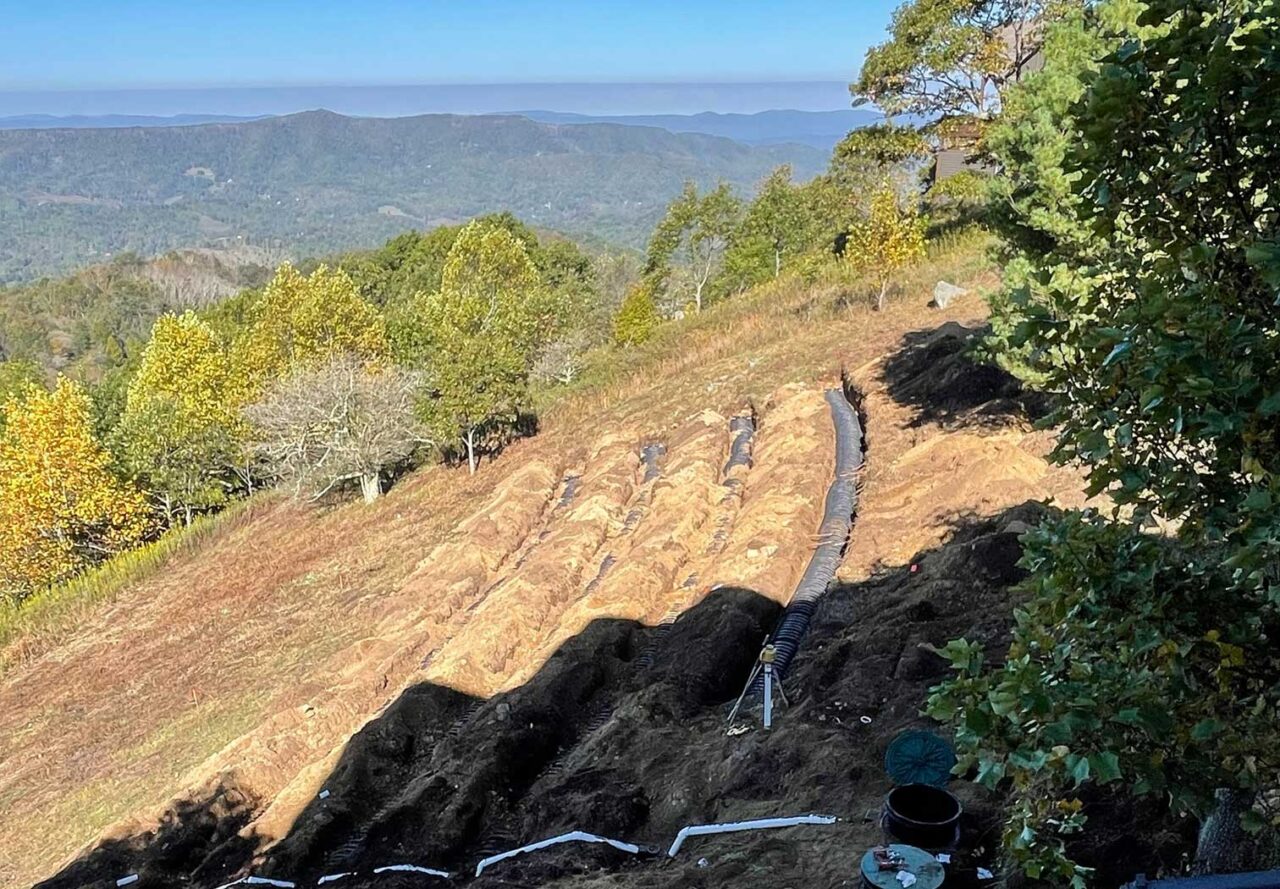
Short answer: yes — more often than most people realize.
A lot that was denied for a conventional septic system is not necessarily unbuildable. It means the county health department evaluated the soil and site conditions under the standard rules and couldn’t approve a gravity-fed trench system. But under North Carolina’s current regulatory framework — 15A NCAC 18E, effective January 1, 2024 — there are multiple pathways that can turn a “denied” lot into a permitted one.
At Land Resource Management, we’ve permitted over 3,500 lots across Western North Carolina, Upstate South Carolina, and East Tennessee. A meaningful percentage of those started as sites that were previously denied or classified as unsuitable by a county environmental health specialist. Here’s how that works.
Why Lots Get Denied in the First Place
When you apply for a septic permit in North Carolina, a county environmental health specialist (or an Authorized Onsite Wastewater Evaluator) evaluates the soil and site conditions on your property. They’re looking at several factors:
- Soil type and texture — clay-heavy soils absorb wastewater slowly; sandy soils may drain too fast.
- Depth to a limiting condition — rock, saprolite, or a seasonal high water table (SHWT) too close to the surface can disqualify conventional systems.
- Slope — steep terrain limits where trenches can be placed safely.
- Available space — the lot must have enough room for both an initial system and a designated repair area.
- Setbacks — minimum distances to wells, property lines, surface water, and structures must be met.
If the site can’t satisfy the requirements for a conventional gravity system — the most common and least expensive option — the application is denied. But that denial is specific to that system type. It doesn’t mean no system will work.
The Engineered Option Permit (EOP)
The EOP is the most common path we use to permit previously denied lots. Under 15A NCAC 18E (and its predecessor rules under 18A .1971), a Licensed Soil Scientist (LSS) can evaluate the site independently, design an engineered wastewater system tailored to the specific soil and site conditions, and submit the package directly to the local health department for permitting.
An EOP allows the designer to work with advanced treatment technologies and system configurations that aren’t available through the conventional permitting track. These might include:
- Low-pressure pipe (LPP) systems that distribute effluent evenly across a larger area
- Drip dispersal systems that deliver treated effluent through subsurface tubing, allowing installation on steep slopes or shallow soils
- Advanced pretreatment units (Type V and Type VI systems under 18E) that treat wastewater to a higher standard before it reaches the soil, reducing the required vertical separation to a limiting condition
- Fill systems where engineered soil media is brought in to create adequate treatment depth above a limiting condition
The key difference is that an EOP is designed by a licensed professional — an LSS — who takes responsibility for matching the system to the actual conditions on the ground, rather than relying solely on the standardized criteria a county agent uses for conventional permits.
The AOWE Private Option
North Carolina also has the Authorized Onsite Wastewater Evaluator (AOWE) private option, which was codified under Session Law 2018-114 and expanded under Session Law 2022-11. This pathway allows an AOWE — a Licensed Soil Scientist who holds AOWE certification — to independently evaluate a site, design a system, and issue a permit without going through the county health department queue.
For landowners and developers, this has two practical advantages. First, turnaround times are significantly faster — LRM typically completes a private option evaluation within five business days, compared to the weeks or months a county office may require. Second, an AOWE brings a higher level of soil science expertise to the evaluation, which often identifies system options that weren’t considered during the initial county review.
What Changed Under the 2024 Rule Update
When the new 18E rules took effect on January 1, 2024, they replaced rules that had been in place since 1990. Several changes directly affect whether a previously denied lot can now be permitted:
More approved system types. Advanced treatment technologies that previously required variance permits or provisional approvals are now fully recognized in the code. This expands the menu of solutions available for difficult sites — particularly in the mountains and Piedmont where challenging soils are the norm.
Updated saprolite classifications. Saprolite — the partially weathered rock between topsoil and bedrock — is extremely common across Western NC. The 2024 rules updated how saprolite is classified for system design purposes, which in some cases opens up sites that were previously denied due to insufficient depth to rock.
Revised repair area requirements. Under the old rules, every lot needed a designated repair area. The 2024 update relaxed this requirement for certain system types, particularly those using advanced treatment that meets specific nitrogen standards. This is significant because many lots were denied not because a system couldn’t work, but because there wasn’t enough space for both an initial and repair field.
Best professional judgment (BPJ) provisions. Session Law 2023-77 expanded the use of BPJ for repairs and certain system designs, giving authorized agents and designers more flexibility to address site-specific conditions that don’t fit neatly into the standard rule tables.
Real-World Scenarios We See Regularly
The mountain lot with shallow rock. A property owner in Buncombe or Henderson County is told the lot has only 18 inches of soil over saprolite — not enough for a conventional system. An EOP with a drip dispersal system and advanced pretreatment can often work in as little as 12 inches of usable soil above the limiting condition, depending on the treatment level achieved.
The steep lot in a subdivision. A builder purchases a lot in a Western NC subdivision and the county denies the conventional permit due to slope exceeding 30%. A low-pressure pipe system designed on contour, or a drip system that follows the terrain, can handle grades that gravity trenches cannot.
The old denial that never got a second look. A landowner has a denial letter from 2015 or 2018 and assumes the lot is unbuildable. The 2024 rule changes, combined with newer treatment technologies that weren’t available or approved when the original evaluation was done, may have changed the equation entirely.
The lot that failed for space, not soil. A small lot in a lake community doesn’t have room for a conventional system plus repair area. Under the 2024 rules, certain advanced systems that meet nitrogen standards can eliminate the repair area requirement, making the lot viable.
What to Do If You Have a Denied Lot
If you own a lot that was previously denied for a septic permit — or if you’re considering purchasing one — the first step is having a Licensed Soil Scientist re-evaluate the site under the current rules. The regulatory landscape has changed substantially, and system technologies have advanced. A denial from five or even two years ago doesn’t necessarily reflect what’s possible today.
At LRM, we handle the entire process: soil evaluation, system design, EOP or private option permitting, and construction oversight. We have a Licensed Soil Scientist and a Professional Engineer on staff, which means EOP submittals don’t require outside subconsultants — we control the timeline and the quality from start to finish.
If you have questions about a specific property, call 828-900-8700 or visit landrm.com to learn more about our septic design and permitting services across Western NC, Upstate SC, and East Tennessee.
Land Resource Management, PLLC is a civil engineering and environmental consulting firm based in Black Mountain, NC, with offices in Waynesville and Boone. LRM holds Licensed Soil Scientist credentials, is registered with NCBELS, and serves developers, builders, and landowners across the western North Carolina mountains, Upstate South Carolina, and East Tennessee.